Crews posted out today — sweeps & brickwork along the battle road Insured • Own Muster • Mon–Fri 7–7, Sat 8–4 Call (781) 778-8605
Mason kneeling at a brick hearth, tending the flue by hand
The Center • East Lexington • Meriam Hill • Follen Hill

Some of These Hearths Warmed Minutemen. They Deserve Masons Who Know It.

Lexington's chimneys run from 1700s center-stack colonials to last decade's gas inserts, and no single trick serves them all. What serves them is judgment — lime mortar where the old brick wants it, stainless where the codes demand it, and an honest reading before any work is proposed. Ring the line and a mason answers it himself, weekdays to seven and Saturday till four.

  • Our own muster on every roof
  • A mason answers the line himself
  • The muster levies not a farthing
  • Terms posted before the first brick
7–7 / 8–4Weekdays to seven; Saturdays till four
38+Years keeping battle-road chimneys sound
4850+Flues mustered, swept or rebuilt to date
$149The captain's dispatch, written on request
The Garrison

Eight Posts, Each Manned by Our Own

No post on this list is hired out or handed off. The crew that musters under this name does the work, at terms you read before anyone climbs, and answers for it afterward.

Sweep at the ridge with his line kit coiled and ready

Minute-Ready Sweeping

Rotary line or rods by the flue's own condition, worked until the camera certifies clean passage — then the smoke shelf and damper done by hand, because the last pass is the one that counts.

  • Tooling picked by the flue's state
  • Certified clean on the scope
  • Shelf and damper done by hand, last
Book a sweeping
Mason giving an elder brick stack its muster in fall light

The Muster

Every element called to account — masonry, flue, crown, cap, flashing — and each answering for its condition. The review costs not a farthing, and the camera falls in whenever proof is wanted.

  • The whole stack called to account
  • Camera runs where proof is wanted
  • The $149 dispatch? Only if asked
Book a free inspection
Brick courses being set along a full mortar bed

Rebuilds That Hold the Line

When a stack is past saving above the roofline, it comes down to brick still fit for duty and goes back up in full beds and true courses, crowned to shed two centuries' more weather if asked.

  • Down only to brick fit for duty
  • Returned in full beds, true lines
  • Crowned for the long watch
Price a rebuild
Trowel making a pointing pass along a stack face

Repointing the Old Colonials

Antique brick fails fastest under modern mortar, so ours is mixed to the house's era — lime-rich and forgiving for the old stacks, harder where the wall was born harder — and struck to match the original hand.

  • Lime-rich mixes for antique walls
  • Joints cut sound, packed full
  • Struck to the original hand
Talk repointing
Capstone being set to stand sentry atop the stack

Caps Standing Sentry

A flue without a cap takes whatever a New England sky sends — rain, sleet, squirrels and the odd nor'easter shingle. A screened stainless cap, seated on a sound crown and fastened, stands the watch instead.

  • Stainless with spark screening
  • Seated on a crown made sound
  • Fastened against the nor'easters
Cap the flue
New flashing fitted and held along the brick seam

Flashing Held at the Breach

The roof-to-brick joint is where most houses are breached, and caulk is a parley, not a defense. We find the true crossing, then set stepped and counter flashing into the masonry so the line actually holds.

  • The breach located, not assumed
  • Step and counter set into the wall
  • Metal holds the line; caulk assists
Mend the flashing
Brush descending past a copper-capped flue gate

Liners for the Unlined Originals

Half this town's older flues were built bare — brick and parging, no tile at all. A one-piece stainless liner, sized right and insulated to clearance, brings an eighteenth-century stack up to this century's safety.

  • One piece, the full height
  • Sized to hearth or appliance
  • Insulated to meet clearances
Plan a liner
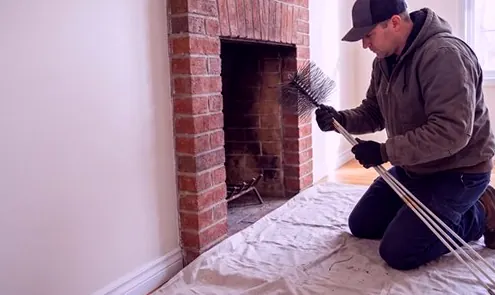
Mason on hearth duty with brushes beside a brick fireplace

Hearths Kept Tavern-Warm

The hearth did this town's cooking, heating and politicking for two centuries; ours get kept to that standard — firebrick rebedded true, the smoke chamber faired for draw, the damper freed to a quiet swing.

  • Firebrick rebedded where it walked
  • The chamber faired for steady draw
  • The damper freed and quieted
Tend a hearth
Signal Lanterns

One Lantern Warned a Colony. Your Chimney Hangs Out Seven.

The whole point of a signal is reading it in time. These are the seven your chimney will hang in the belfry before anything serious rides in.

  • Smoke retreating into the roomThe draft has broken ranks — something cold, closed or blocked above.
  • Mortar grit on the hearthstoneJoints above surrendering grain by grain — old lime going to powder.
  • White powder ghosting the brickWater on the march through the masonry, leaving its salts behind.
  • A stain surfacing rooms awayThe entry is at the top; the stain only marks where the water dismounted.
  • A black glaze inside the flueCreosote at its worst rank — the grade that starts fires and ignores brushes.
  • Rust running from the roof seamFlashing past its enlistment — the photograph shows the final parade.
  • No muster in living memoryAn unreviewed chimney keeps its own counsel. The review here is free.

Get the Free Inspection

Rusted-through flashing hanging its alarm sign at a chimney base
The line is manned six days Flashing in this state surrendered seasons ago and the water has been billeting in your framing since. Describe it to the mason who answers — weekdays 7 to 7, Saturday 8 to 4 — and you'll know its urgency before the call ends. After hours, the recorder posts you first for Monday.
The Drill

Four Commands, Given in the Same Order Every Time

Militias drilled until the sequence was second nature, and so has this crew. No step gets skipped, and no figure appears that wasn't announced.

1

Sound the Call

A mason answers weekdays 7 to 7 and Saturday 8 to 4. Report what you've seen and claim a day that suits.

2

The Muster

The full review at no levy, with every finding reported to your face in plain parade-ground English.

3

Terms Posted

Repairs listed singly, urgent divided from advisable, each with a figure that holds from posting to invoice.

4

Stand Down Clean

The work done to the town standard, the ground policed spotless, and the warranty delivered in writing.

Mason at a chimney crown with the town spread below at dusk
Before the Cold Rides In

Winter Doesn't Send a Rider Ahead. Your Chimney Can Still Be Ready.

The first real cold reaches Middlesex County overnight, every year, on no particular date. The households that mustered their flues in the fall just light the fire and get on with it. One call books yours — and the muster still levies not a farthing.

(781) 778-8605
The Muster Roll

Entered on the Roll This Season

Recent entries — flues certified clean, colonial joints renewed, caps posted sentry and hearths brought back to warmth across the battle-road towns.

Line kit coiled at the ridge
Swept and certified — Meriam Hill
Pointing pass along the stack face
Lime joints renewed — The Center
Capstone taking its sentry post
Cap posted sentry — Follen Hill
Flashing seam newly held in metal
Breach held — East Lexington
Elder stack under its muster
Mustered and passed — Bedford
Spent flashing before replacement
Lantern answered — Burlington
Brush descent past the copper gate
Liner surveyed — Arlington
Course line setting into its bed
Line held, rebuilt — Winchester
High tending of an open-sky stack
Upper courses trued — Lincoln
Evening plume drawing steady over the green
Drawing steady at dusk — Concord
The Colony

Riding From the Green to Every Neighboring Town

The company keeps its quarters on Bedford St above the Center; the rounds cover Lexington's hills and the towns the alarm riders reached first.

  • Lexington Center
  • East Lexington
  • Meriam Hill
  • Follen Hill
  • Loring Hill
  • Countryside
  • Bedford
  • Burlington
  • Arlington
  • Winchester
  • Woburn
  • Belmont
  • Waltham
  • Lincoln
  • Concord
  • Carlisle

Past the alarm routes? Call (781) 778-8605 — the riders range beyond the printed towns.

At the Tavern Table

The Questions That Cross the Table Most

Not a farthing — truly? What does the free muster cover?

Truly, and it covers the lot. The mason starts at the firebox — throat, damper, surround — follows the flue its entire run, then moves to the weather face — crown, cap, flashing, and every course of brick standing out in a New England year. Draft is tested; creosote is graded; anything doubtful gets a second look rather than a guess. You hear it all face to face before the truck leaves, and the levy for that is zero. The only paid article in the house is the captain's dispatch — the muster set down formally with photographs and a figure beside each repair, $149 — and it gets written only when you ask for it. Decline it and the visit closes at nothing owed, as advertised.

What happens outside your hours — Saturday evening, or a Sunday?

The recorder stands the watch, and we say so plainly rather than let the ring mislead you. A mason holds this line weekdays from 7 to 7 and Saturdays from 8 to 4; messages left after Saturday's stand-down or on Sunday get the first calls when Monday opens. One alarm outranks every schedule: flame where it shouldn't be, or any whisper of carbon monoxide, and the drill is fixed — muster everyone outside first and raise 911 before any other call. Ours keeps until the danger is past.

We have a 1700s center-chimney colonial. Do you actually know these houses?

They're the reason to work in this town. A center-chimney colonial carries the whole house around one great stack — sometimes five flues, a beehive oven and three fireplaces sharing a single mass of brick that's been settling since before the Revolution. Those stacks want a particular hand: lime-rich mortar that moves the way the original did, flues treated one at a time on their own condition, and a deep suspicion of anyone proposing to 'modernize' what mostly needs honest maintenance. Work in the historic districts also means matching what the street sees, and we build that into the plan rather than treating it as a surprise.

Our flue has no liner at all — the inspector called it 'original.' How bad is that?

Common around here, and worth taking seriously without panic. Houses built before the early 1900s often run bare brick flues — no clay tile, just parged mortar that a century of fires and frosts has been quietly eating. The risk is simple: gaps in old mortar joints can let heat and gas reach framing that was built tight against the stack. The remedy is well established — a stainless liner sized to the fireplace or appliance, run the full height in one piece, insulated where the clearances call for it — and it preserves the look of the chimney entirely. The muster will tell you honestly whether yours is a this-season job or a keep-an-eye job; plenty are the second kind.

How often should a chimney be swept in New England?

Once each burning season for a fireplace in regular use — and the season here is long enough to earn it. Book after the final fire of spring or early in the fall before the calendar crowds; either serves, provided it happens every year. A flue idle since spring deserves eyes before the first match regardless, because capless or quiet chimneys collect squirrels, starlings and doubt. Oil and gas heating flues want a yearly visit of their own — what gathers in them is corrosive, shows nothing at the hearth, and runs ahead of every estimate.

The buyer's inspector red-flagged our chimney, and closing is this month. In time?

Yes — this is the most scheduled-around emergency we handle. The free muster goes on the books within days; a camera run settles any point the inspector could only see from the yard; and when the table needs paper, the $149 captain's dispatch arrives before your deadline with findings, photographs and per-repair figures. Around Lexington, where half the disputed chimneys are older than the republic, a specific number from someone who actually climbed the thing tends to end the argument.

Who shows up, and are they insured for working on my roof?

Our own crew, mustered from our own payroll — no labor borrowed by the weekend, no stranger introduced at your door. Every man passed a background check before his first roll call, and both of the firm's policies — general liability and workers' comp — stand behind every visit. Say the word at booking and the certificate of insurance travels out ahead of the ladder. Any outfit that bristles at that request has told you what you needed to know.

Is the parlor going to smell of soot afterward?

Not under this flag. Runners cover the path from the door, the fireplace opening is sealed behind sheeting, and a HEPA-filtered vacuum holds suction on the flue every minute a brush is working — the soot musters into the canister and nowhere else. An ordinary flue runs about an hour. When we stand down, the parlor should look untouched and the chimney should draw like it finally remembered how.

The Bedford St Quarters

One Line. A Mason Holding It. Five and a Half Days a Week.

No forms and no dispatch desk between you and an answer. The man on this line can read a job from your telling of it, give a range that survives to the invoice, and enter your date on the roll before you hang up.

  • The quarters420 Bedford St #100
    Lexington, MA 02420
  • The roundsLexington and the battle-road towns on every side

When the line is manned

Mon – Fri
7 to 7, the mason himself
Saturday
8 to 4, then the crew stands down
Sunday
The Green is quiet — the recorder takes the watch
A mason mans this line

Report What You've Sighted. The Line Does the Rest.

The smoke that fell back into the parlor, the grit collecting on the hearthstone, the streak widening below the roof — report it the way you'd report any sighting: what, where, since when. You'll get a reading you can act on and a figure that won't desert you at invoice time.

(781) 778-8605 Tap to Call Now

Manned Mon–Fri 7–7, Sat 8–4
Sundays the recorder watches; Monday rides out on your word

The order of the call

  1. Your street, and the signals you've sighted.
  2. A frank reading of how urgent they sound.
  3. A date on the roll, Monday through Saturday.
  4. The muster free; terms posted before work.
Tap the line — Mon–Fri 7–7, Sat 8–4(781) 778-8605